

Analytical Assessment of Leachables in Biological Drug Products: FDA Approach in Reviewing Information
About this event
Biological drug products (biologicals; such as therapeutic proteins, vaccine-, gene-, and cell therapy-based) are produced via multi-step processes involving multiple materials contacting intermediates and sourcing numerous leachables into final drug products (DP). , (ii) shelf-life storage and (iii) in-use hold of DP.
The respective contact materials involve chromatography resins, filtering/dialysis membranes, tubing, collecting bags/tanks, gaskets, valves, final container closure systems, etc. By these, the assessment of leachables risk in biologics is the most challenging compared to other types of DPs.
However, current guidances are generally focused on assessment of the leachables only from single manufacturing components, scored to be high-risk for leachables, and by this, underestimate other components scored to have the lower risk.
Following these directions, manufacturers typically perform the assessments only for the high-risk components and by this, underestimate the contribution of other materials to the overall (cumulative) leachables profile in final DP.
Other typical issues involve (i) non-validation of analytical methods, resulting in ambiguity in Analytical Uncertainty Factor (AUF) used for calculation of the Analytical Evaluation Threshold (AET; reporting limit in an assay), (ii) missing the assessment of elemental (ionic) leachables, or (iii) incorrect leachables study design; altogether also resulting in potential underestimation of the leachables risk.
These issues usually cause multiple back-and-forth communications between the FDA and Sponsor during the applications’ (BLAs and supplements) review, typically ending up with post-marketing requirements (PMR) and putting an unnecessary burden on both sides.
This presentation overviews an FDA approach and experience in reviewing information for analytical assessment of leachables, including examples of the review cases and found issues, aimed to reduce the efforts of both sides in the review process and facilitate proper evaluation of the leachables risk, and also used in preparation of the current ICH Q3E guidance draft.
What you'll learn
- Research interests: structure-function of blood coagulation factor VIII, mechanisms of FVIII clearance from the circulation, treatment of Hemophilia A, blood coagulation mechanisms.
- Regulatory work at FDA: review of information for drug products based on therapeutic proteins, for gene therapy, cell therapy and tissue-engineered products with additional focus on review of extractables and leachables assessment.
- J. H. Holland Laboratory of the American Red Cross (Rockville, MD), 1998-2004;
- University of Maryland School of Medicine (Baltimore, MD), 2004-2006;
- Armed Forces Institute of Pathology, Walter Reed Army Medical Center (Washington, DC), 2006-2008.
- BS/MS in Biochemistry – 1982, Moscow State University, USSR.
- PhD in Molecular Biology – 1998, Engelhard Institute of Molecular Biology, Russian Academy of Sciences, Moscow.
Topics covered
Frequently asked questions
Who is hosting Analytical Assessment of Leachables in Biological Drug Products: FDA Approach in Reviewing Information?
Analytical Assessment of Leachables in Biological Drug Products: FDA Approach in Reviewing Information is hosted by BioPharma Webinars.
When is Analytical Assessment of Leachables in Biological Drug Products: FDA Approach in Reviewing Information?
Analytical Assessment of Leachables in Biological Drug Products: FDA Approach in Reviewing Information is scheduled for Monday, March 25, 2024.
Where does registration take place?
Registration or viewing is completed on BioPharma Webinars's website.
What format is this event?
This is an online webinar.
Which topics does this event cover?
The event covers Marketing, HR, and Data.
More from 888 Publishing
View all →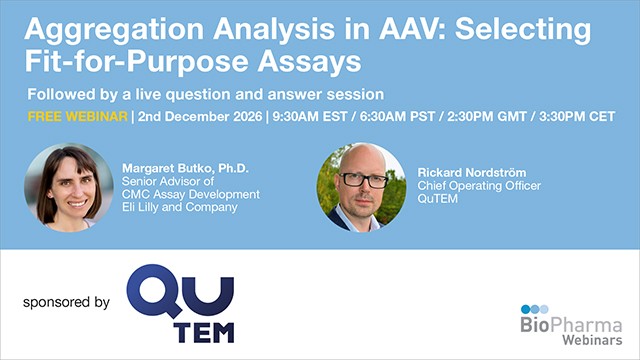
Available on demand
Aggregation Analysis in AAV: Selecting Fit-for-Purpose Assays
888 Publishing

Available on demand
Enhancing Plasmid DNA Quality Through Robust Topology Measurement
888 Publishing

Available on demand
Characterization of Lipid Nanoparticles Using Macro Mass Photometry Insights into Size & Mass
888 Publishing